

Non-compliance with New Zealand fire and property laws can cost thousands in fines per breach, invalidate insurance and expose landlords, bodies corporate and portfolio owners to prosecution. Working smoke alarms, Building Warrant of Fitness obligations and health and safety duties are non-negotiable; a proactive, systemised approach is the only reliable way to protect people and assets.
Table of Contents
Introduction – why fire compliance in NZ really matters
Fire compliance is the sharp end of property risk in New Zealand – one overlooked smoke alarm, missed inspection or outdated evacuation plan can turn into injury, litigation and six-figure financial loss. For a Beginner Investor, a Body Corporate Manager or a Property Portfolio Manager, fire obligations are not just “red tape”; they are core to tenant safety, insurance validity and asset protection across every dwelling or multi-unit site.
New Zealand law now treats many landlords and bodies corporate as PCBUs (Persons Conducting a Business or Undertaking) under the Health and Safety at Work Act 2015; that means directors and decision-makers can personally face penalties if they allow unsafe conditions to persist. Understanding the cost of non-compliance is therefore essential to any modern property compliance strategy.
Financial risks of non-compliance
The most visible cost is direct fines – but for serious investors and bodies corporate, the indirect financial damage is often greater and longer lasting.
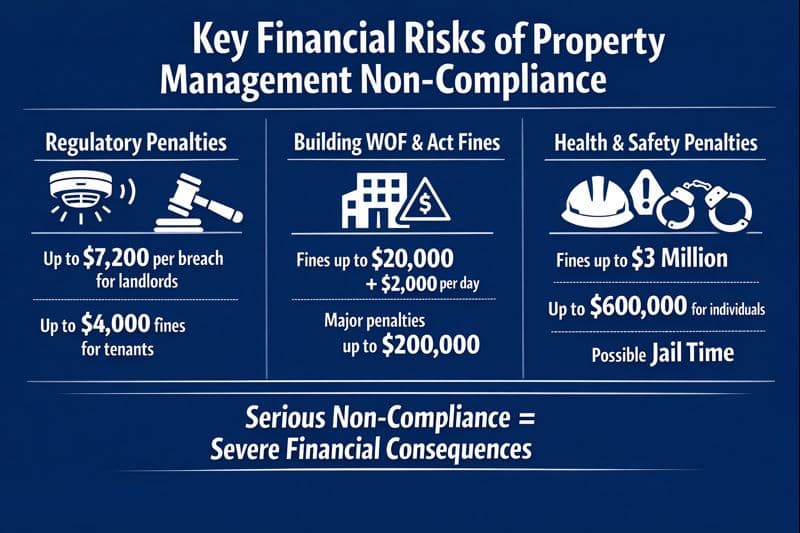
Key financial risks include
- Regulatory penalties – Tenancy Services confirms landlords who fail to meet smoke alarm obligations can face penalties of up to $7,200 per breach, while tenants who tamper with alarms can be fined up to $4,000.
- Building WOF and Building Act fines – Failing to obtain or display a Building Warrant of Fitness, or ignoring a Notice to Fix, can attract fines up to $20,000 plus $2,000 per day; in serious cases, owners can face penalties up to $200,000 with additional daily fines.
- Health and Safety penalties – Under HSWA, fines for PCBUs can reach $3 million and up to $600,000 for individuals, with potential imprisonment if serious negligence is proven.
Beyond the headline penalties, non-compliance can trigger:
- Higher insurance premiums or outright refusal to insure non-compliant buildings.
- Forced vacancies while fire or seismic issues are remediated – a major concern for a Property Portfolio Manager with leveraged holdings.
- Depressed resale values or forced price discounts for buildings with poor compliance history or unresolved Notices to Fix.
Legal consequences
From a legal perspective, non-compliance changes the risk profile for every decision-maker in the ownership chain.
For a Beginner Investor, key legal risks include Tenancy Tribunal orders, exemplary damages and enforceable work orders when Healthy Homes or smoke alarm duties are ignored. For a Body Corporate Manager, exposure extends to the body corporate entity and sometimes committee members personally if they knowingly allow unsafe systems, expired BWOFs or non-compliant fire protection to continue.
Under the Health and Safety at Work Act 2015, most landlords and body corporates are treated as PCBUs and must ensure, so far as reasonably practicable, that premises used as a workplace are without risk to health and safety. Legal consequences can include:
- Prosecution by WorkSafe for serious safety failures.
- Enforcement action by councils under the Building Act for BWOF or seismic non-compliance.
- Tribunal or court-ordered compensation to tenants for losses arising directly from unsafe or non-compliant conditions.
Ignorance is not a defence in these regimes; regulators expect owners and managers to actively identify and control risks.
Non-compliance penalties in practice
Penalties are structured to scale with the seriousness of the breach and the level of responsibility of the party involved.
Representative examples
- Smoke alarms in rentals – Up to $7,200 for landlords who fail to provide compliant, working alarms at the start of a tenancy; up to $4,000 for tenants who damage or disable alarms.
- Healthy Homes documentation – Failing to include a healthy homes compliance statement when required can result in penalties of up to $500 per tenancy plus potential further enforcement action.
- Building Warrant of Fitness – Failing to obtain or display a required BWOF, or providing a false BWOF, can attract infringement fines between $250 and $1,000 and, on conviction, fines up to $20,000 or more; failure to comply with a Notice to Fix can lead to penalties up to $200,000 plus $20,000 per day.
- Health and Safety at Work Act – Landlords and bodies corporate as PCBUs can face fines up to $600,000 for individuals and $3 million for companies where serious breaches of duty occur.
For a Property Portfolio Manager operating at scale, these figures compound rapidly if systemic issues are uncovered across multiple properties; a repeated smoke alarm or BWOF failure pattern can become a seven-figure risk exposure.
How to avoid non-compliance risks
The most effective protection for property owners, investors and body corporate managers is a structured, system-based approach to compliance that treats safety and regulation as ongoing disciplines, not one-off tasks.
Practical strategies
- Build a central compliance register – Maintain a single source of truth for each property; record BWOF expiry dates, specified systems, smoke alarm installation dates, Healthy Homes deadlines and HSWA risk assessments.
- Use licensed, specialist contractors – Engage IQPs for specified systems, qualified electricians and fire technicians for alarms and emergency lighting; this is critical for bodies corporate managing lifts, sprinklers and shared alarms.
- Schedule recurring audits – Annual fire safety and BWOF reviews, plus periodic Healthy Homes and HSWA checks, help a Beginner Investor spot issues before they reach the Tribunal and help a Property Portfolio Manager identify systemic gaps across the portfolio.
- Formalise roles and PCBU duties – Clarify in writing how responsibilities are shared between owners, property managers, body corporate committees and contractors under HSWA; keep records of consultations, hazard identification and risk controls.
- Align compliance with capital planning – Integrate fire upgrades, seismic strengthening and plant renewals into long-term maintenance plans rather than treating them as surprises; this is especially important for bodies corporate managing aged multi-unit stock.
- Educate tenants and residents – Provide clear guidance on not tampering with alarms, reporting hazards promptly and respecting evacuation procedures; tenant behaviour is a critical risk lever in multi-unit fire safety.
Hallmark and Stone typically help clients establish these frameworks once, then keep them updated as legislation and building conditions change, which is particularly valuable for time-poor investors and committee-based governance structures.
Hallmark & Stone’s Expertise
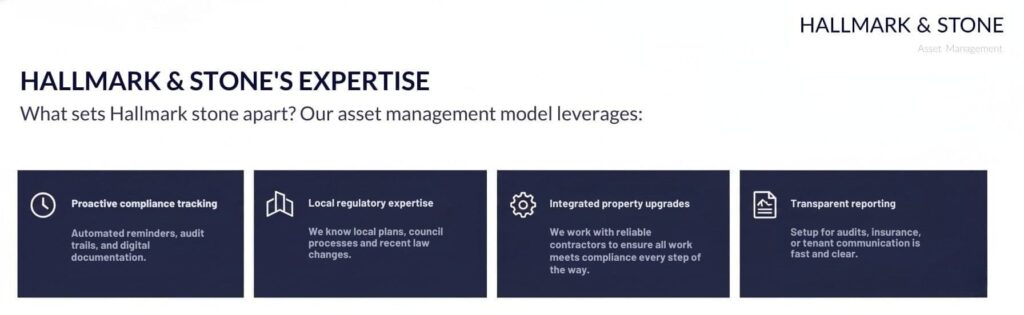
What sets Hallmark & Stone apart? Our asset management model leverages:
- Proactive compliance tracking: Automated reminders, audit trails, and digital documentation.
- Local regulatory expertise: We know local plans, council processes, and recent law changes.
- Integrated property upgrades: We work with reliable contractors to ensure all work meets compliance every step of the way.
- Transparent reporting: Setup for audits, insurance, or tenant communication is fast and clear.
Unlike basic managers who focus only on repairs and rent collection, our service actively seeks out compliance risks, resolves them before they escalate, and ensures you’re always prepared for inspections or legislative updates.
Talk to the team at Hallmark & Stone today and see how we can ensure you remain compliant – whether you are managing your first investment property or you are a Body Corporate Manager with a large portfolio.
Conclusion
The cost of non-compliance in New Zealand is measured not only in fines but also in reputational damage, lost rent, legal exposure and compromised safety outcomes for residents and workers. For a Beginner Investor, Body Corporate Manager or Property Portfolio Manager, the real risk lies in fragmented processes and assumptions that “someone else is looking after it.”
Turning compliance into a structured, data-driven discipline protects people, preserves insurance and underpins long-term asset performance, while also demonstrating to regulators and occupants that safety is non-negotiable.
Frequently asked questions
Can individual unit owners be fined for non-compliance?
Yes, individual owners in a unit title or body corporate context can be held responsible if they are the legal landlord for a tenanted unit or if their actions create specific breaches, such as failing to provide smoke alarms in their rental or ignoring a Healthy Homes statement obligation. Where HSWA applies, an individual owner who is a PCBU or an officer can also face fines up to $600,000 for serious safety failures.
Can a landlord be fined for not installing smoke alarms?
Yes, Tenancy Services confirms landlords must provide working, compliant smoke alarms and that failing to do so can result in penalties of up to $7,200 per breach. Tenants who remove or damage alarms also face penalties of up to $4,000, so both sides have legal responsibilities.
Which laws govern property compliance penalties?
Key legislation includes the Residential Tenancies Act 1986 and associated regulations, such as the Residential Tenancies (Smoke Alarms and Insulation) Regulations 2016 and Healthy Homes standards; the Building Act 2004 and Building Code, which set BWOF and structural obligations; and the Health and Safety at Work Act 2015, which governs PCBU duties and major safety penalties. Local council bylaws and Fire and Emergency New Zealand requirements also influence enforcement around fire safety, evacuation and use of buildings.
